The W2 + 1099 Tax Shield: Subsidizing Your Premium Lifestyle
Earning a high W2 salary means surrendering a massive portion of your income to taxes before the money even hits your bank account. Here is how operating a secondary 1099 business allows you to legally acquire top-tier tech and travel assets with pre-tax dollars.
If you spend enough time looking at a standard W2 pay stub, the math becomes incredibly frustrating. As a salaried employee, you have absolutely zero leverage over your tax burden. The government takes its thirty or forty percent right off the top, and you are left to fund your entire life—your rent, your travel, and your hardware—using whatever after-tax dollars are left over.
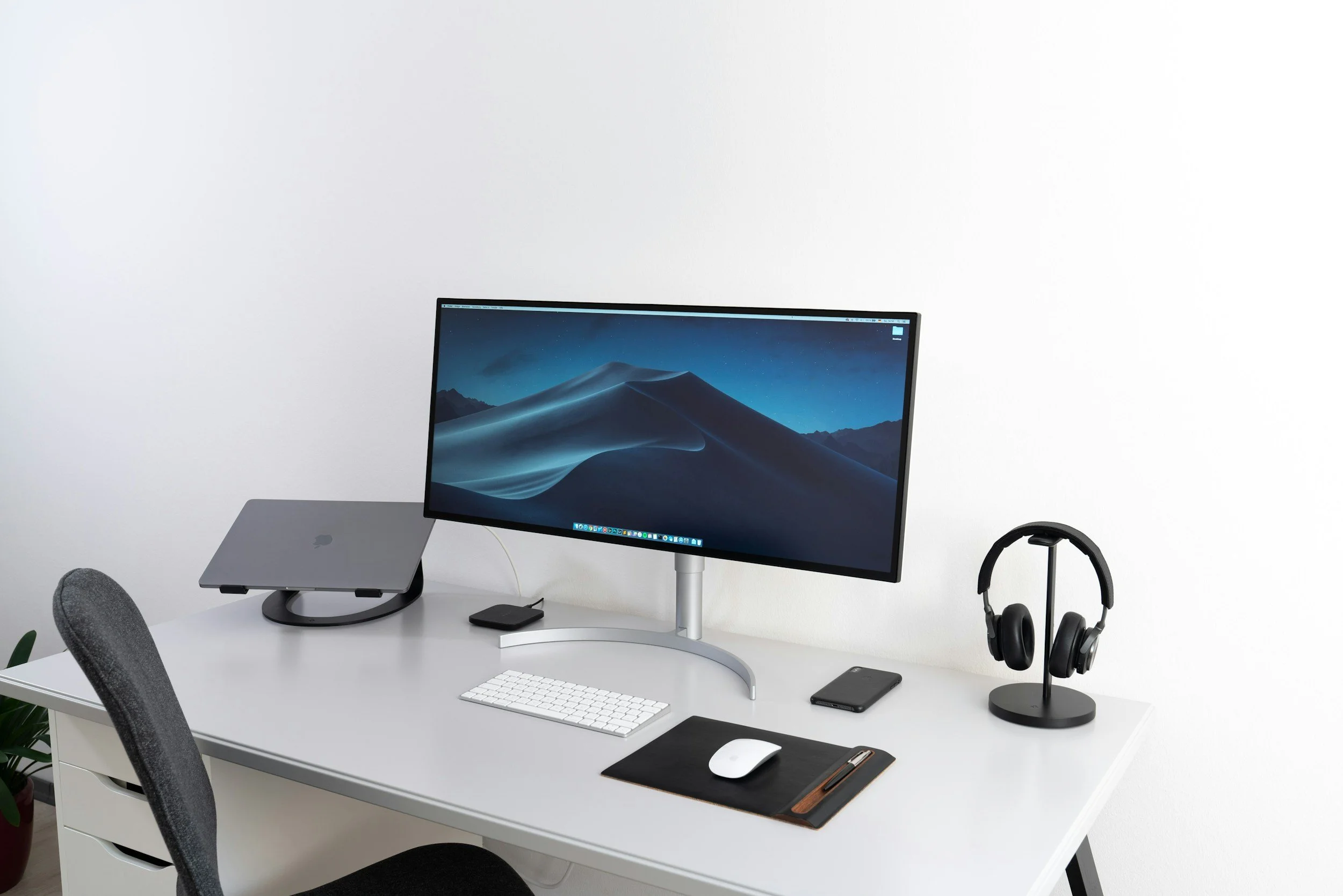
When you want to upgrade your home office with a $1,300 ultra-wide monitor, you aren't just paying $1,300. Because you are buying it with after-tax money, you actually had to earn closer to $1,900 at your day job just to bring that single piece of glass home.
This is exactly why high-earning professionals eventually realize that a 1099 side business is not just a secondary income stream. It is a protective tax shield.
The Schedule C Arbitrage
The moment you establish an independent contracting business, an LLC, or a consulting practice, the rules of the financial game fundamentally change.
While W2 employees are taxed before they spend, 1099 contractors are taxed after they spend. The IRS allows independent business owners to deduct the legitimate, ordinary, and necessary costs of running their operations directly against their gross revenue on a Schedule C form.
This means that instead of buying a laptop with the money left over after taxes, you buy the laptop through the business first, and you only pay taxes on the profit that remains. You are effectively acquiring premium infrastructure at a massive, legally sanctioned discount.
Liquidating the Hardware Costs
When you start viewing your tech acquisitions through the lens of a 1099 business, the price tags on premium gear suddenly become much less intimidating.
Take the Dell UltraSharp 49 Monitor or the Tumi Alpha 3 Brief Pack we reviewed recently. If you are running a legitimate consulting practice, managing an e-commerce portfolio, or doing freelance photography, you mathematically require a high-end visual canvas to cross-reference spreadsheets and a secure ballistic nylon vault to transport your dual laptops to client meetings.
Because these are required tools for your independent work, they are standard business deductions. You purchase them using the revenue generated from your 1099 contracts. By doing so, you lower your total taxable business income for the year, effectively forcing the government to subsidize a portion of your daily carry and your home office setup.
Other ideas for products you may need for your business to expense :
Mechanical Keyboard
Logitech MX Master 4 Mouse
Monitor Light
Herman Miller Desk Chair
Standing Desk
DSLR Camera
Laser Printer
Shipping Labels / Printer
Charging blocks/cables
Docking Stations
Laptop stand
SD cards/Hard drives
Macbook Pro
Mouse pads/ergonomic pads
Webcam / Microphone
Headphones
The Travel Integration Strategy
The tax shield becomes significantly more lucrative when you apply it to your travel strategy.
Let’s say you are planning to fly to Tokyo. If it is purely a vacation, every flight, hotel, and meal is paid for with your heavily taxed W2 savings. But if you are operating a business, you can strategically integrate your operations into the itinerary.
If you are an e-commerce operator flying to Asia to meet with manufacturing suppliers, or a travel consultant touring and reviewing properties like the Park Hyatt Kyoto for your website, the financial structure of the trip changes. The flights, the transportation, and a portion of your meals and lodging transition into legitimate business expenses.
When you combine this with the Chase to Hyatt Pipeline and the Amex Positioning Flight Strategy, the synergy is incredible. You use your credit card points to cover the massive upfront costs of the business class flights and luxury hotels, and you write off the cash incidentals—like bullet train tickets, Wi-Fi, and business dinners—against your 1099 income.
The Mindset Shift
Operating a 1099 business alongside your W2 job requires a fundamental shift in how you view capital. You have to stop looking at high-end laptops, server arrays, and international flights as "expensive purchases."
Instead, you need to view them as strategic infrastructure investments that actively reduce your end-of-year tax liability. You are simply redirecting capital that would have otherwise gone straight to the IRS, and using it to build a highly optimized, fully subsidized lifestyle.
(Disclaimer: I am not a CPA. You should always consult with a licensed tax professional to ensure your specific deductions align with current tax codes and that your 1099 business meets the IRS criteria for legitimate operations).
The Auditory Vault: Surviving the 14-Hour Pacific Crossing
Commercial aircraft cabins are incredibly hostile environments. Here is why investing in true acoustic isolation is the single most important hardware choice for long-haul travel, and exactly which headset actually gets the job done.
When you finally secure that elusive lie-flat business class seat to Tokyo using the Chase to Hyatt pipeline, it is easy to assume the hard work is over. You settle into your pod, accept the pre-departure champagne, and wait for takeoff. But the moment those massive twin engines spool up, you are suddenly reminded of a harsh reality: commercial aircraft are incredibly loud, physically exhausting environments.
For the next fourteen hours, you will be subjected to a constant 85-decibel drone. That low-frequency rumble does not just ruin your ability to watch a movie; it causes genuine physical fatigue. You land feeling drained, and it isn't just because of the time zone change. You are exhausted from the acoustic assault. To actually enjoy a long-haul flight, you must invest in an auditory vault.
While the market is flooded with premium noise-canceling options, evaluating them strictly through the lens of international travel quickly eliminates the most popular contenders.
The Weight Liability
If you walk through any first-class lounge, you will inevitably see dozens of travelers wearing the Apple AirPods Max. From a purely aesthetic standpoint, they are gorgeous pieces of hardware. But from an operational standpoint, they are a massive liability for a fourteen-hour flight.
Because Apple chose to construct the ear cups out of solid aluminum and stainless steel, the headset weighs a staggering 385 grams. That is over half a pound of metal resting directly on your neck. While the mesh canopy tries to distribute the weight, you will absolutely feel that pressure after hour six over the Pacific.
Worse is the travel profile. The AirPods Max do not fold, and they come with a flimsy polyurethane sleeve that leaves the metal canopy completely exposed. If you are sliding these into a tightly packed carry-on bag, you are essentially asking for them to get crushed or scratched against your laptop.
The Spatial Compromise
The next natural pivot is usually the Sony WH-1000XM5. Sony has built a massive reputation for class-leading active noise cancellation, and the sound profile is undeniably excellent.
However, when Sony redesigned this flagship headset, they made one fatal flaw for frequent flyers: they removed the folding hinges. The ear cups lay flat, but they do not collapse inward. Because of this, the included protective travel case is comically large. When you are traveling carry-on only and every cubic inch of your Briggs & Riley bag is heavily calculated, dedicating that much internal real estate to a headphone case creates unnecessary friction in your packing strategy.
The Ultimate Acquisition
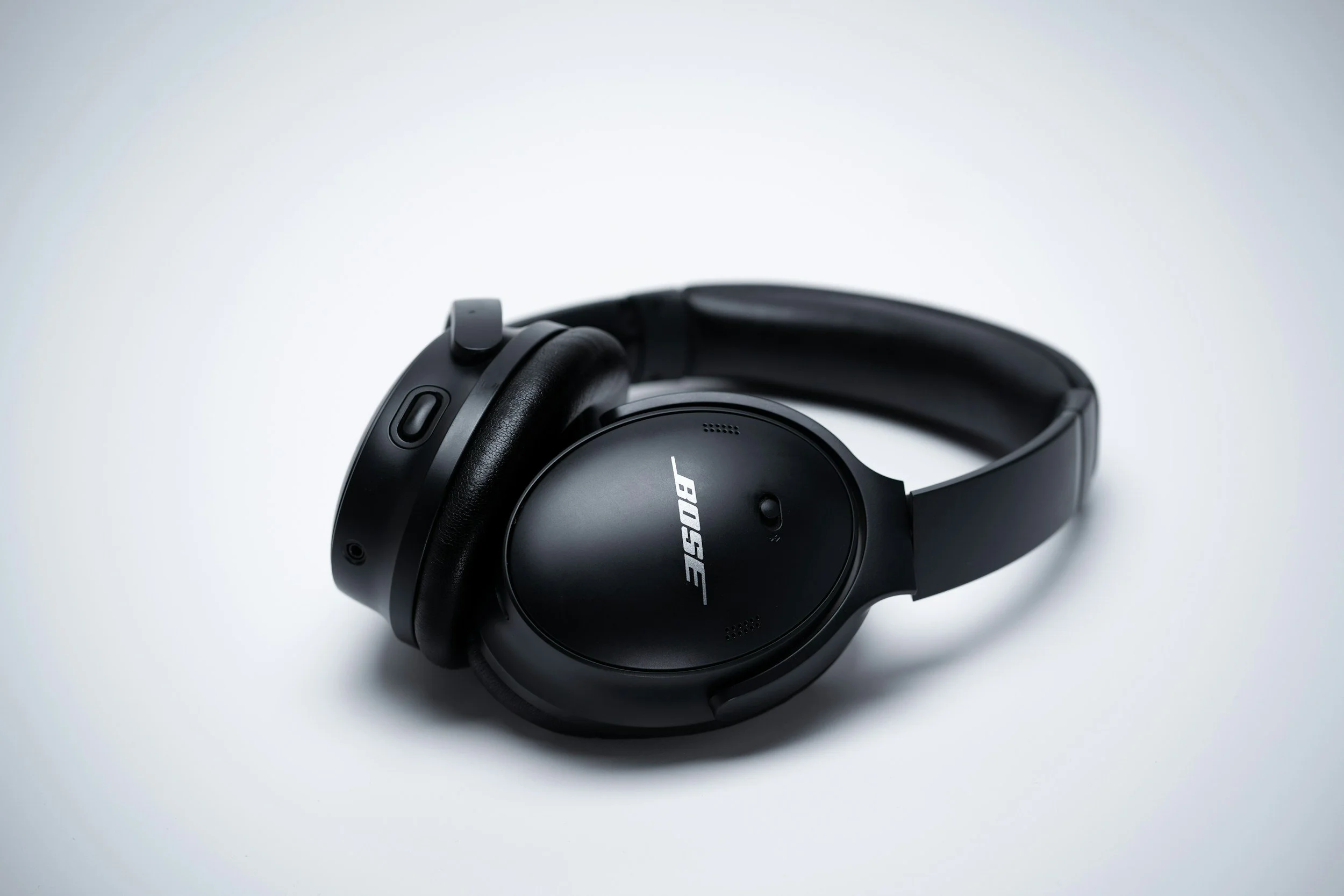
To survive an ultra-long-haul flight, you need a headset that strikes the perfect mathematical balance between acoustic isolation, physical weight, and spatial efficiency. The premier asset in this category remains the Bose QuietComfort Ultra.
Retailing for roughly $449, the QuietComfort Ultra represents the gold standard for travel hardware. While other brands have drifted toward heavy luxury materials or rigid designs, Bose remembered exactly who their core demographic is: the frequent flyer.
Here is why they fundamentally outclass the competition in the air:
The Weight Profile: At just 250 grams, they are drastically lighter than the Apple alternative. The clamping force is dialed in so perfectly that you genuinely forget you are wearing them after the first hour.
The Folding Architecture: Unlike the Sony XM5 or the AirPods Max, the Bose Ultras retain traditional folding hinges. They collapse tightly into a slim, rigid travel case that easily slides into the front pocket of a backpack without warping your laptop compartment.
The Acoustic Engine: Bose essentially invented consumer active noise cancellation, and the Ultra model is terrifyingly good at its job. It specifically targets and neutralizes the exact low-frequency drone of jet engines, dropping the cabin volume to a quiet whisper so you can actually sleep.
The Battery Math: With a 24 to 30-hour continuous battery life, you can turn the noise cancellation on at LAX, fly all the way to Tokyo, take a bullet train to Kyoto, and still have enough juice left to walk to your hotel in complete silence.
The Interlinking Strategy
Get your Bose QuietComfort Ultra here
When you are ready to acquire a $400+ piece of audio hardware, never put it on a standard debit card. If you accidentally leave these in the seatback pocket or drop them on the tarmac, you want your bank to cover the replacement cost.
If you haven't already, review the Amex Platinum Purchase Protection Protocol. You can use your premium credit card to effectively insure this headset for free, ensuring your travel capital is perfectly protected.
Getting away from the Permanent Cloud Storage Tax
Storing heavy contract files, 4K travel footage, and 360-degree videos on fragile external drives is a catastrophic liability. Here is the enterprise-grade infrastructure to bring your data in-house.
The Storage Deficit
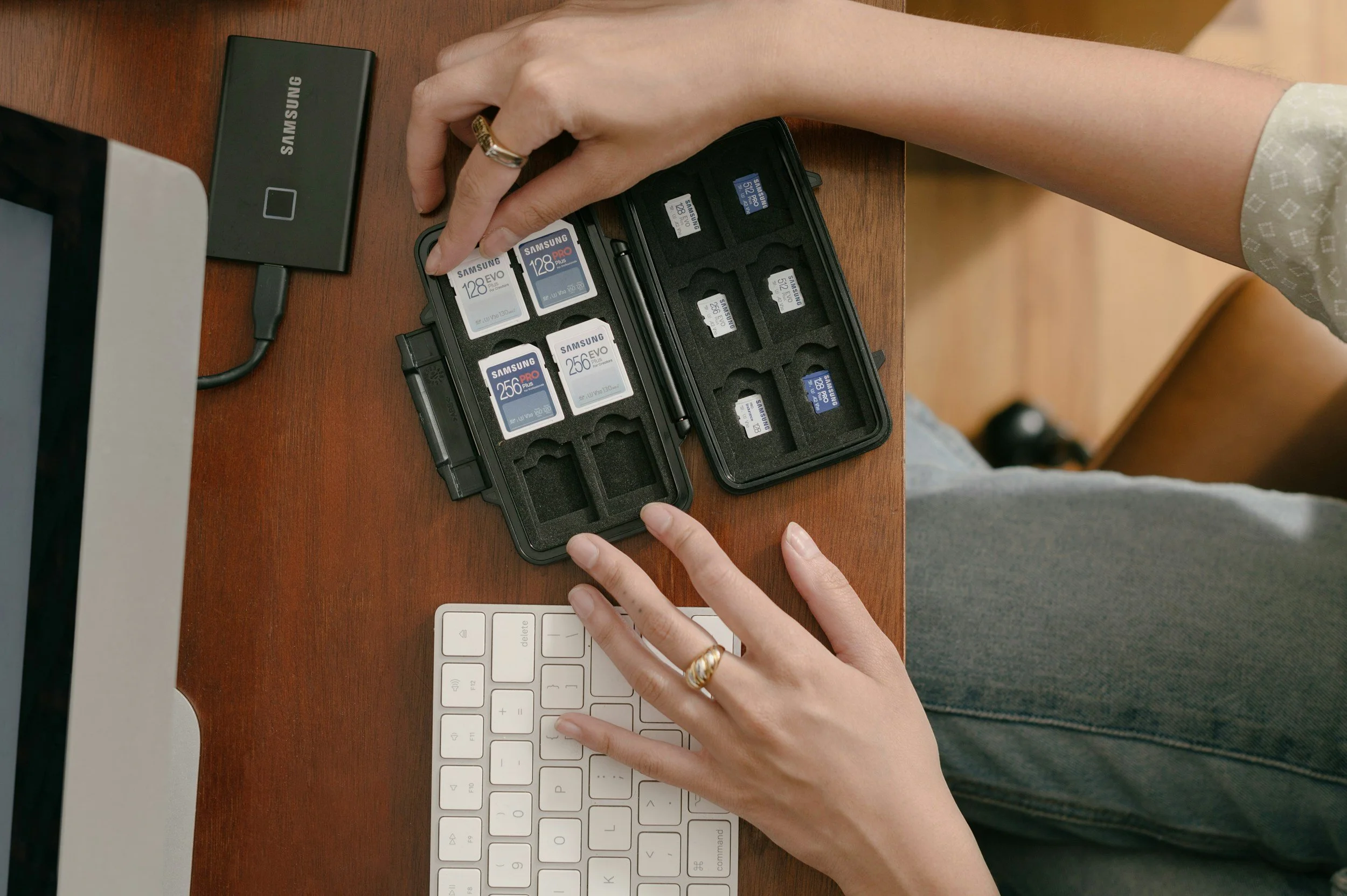
Most professionals manage their digital assets with extreme negligence. They buy a $100 plastic external hard drive, drop it on their desk, and assume their business operations are safe. A single spilled coffee or a mechanical "click of death" inside that drive instantly wipes out years of client deliverables, financial spreadsheets, and irreplaceable travel media.
The amateur alternative is paying a monthly tax to a cloud provider. Renting space from Dropbox or Apple seems cheap at $10 a month initially. But as your digital footprint grows—especially when capturing massive 4K files from a DJI drone or storing hundreds of high-fidelity diamond inspection videos for your website—that monthly fee scales aggressively.
You end up paying $30 to $50 a month, in perpetuity, to rent server space. Over a ten-year timeline, you bleed thousands of dollars just to access your own files. You must stop renting your infrastructure and build a private data vault.
The Synology Acquisition
The premier asset for localized data sovereignty is the Synology DS923+ 4-Bay DiskStation.
This is not a basic hard drive. It is a Network Attached Storage (NAS) server. It sits quietly next to your ultra-wide monitor, plugs directly into your router, and acts as your own private, encrypted cloud. You can access your files from a hotel room in Tokyo just as easily as you can from your home office, entirely bypassing third-party subscription fees.
The RAID Insurance Policy
The engineering feature that justifies the capital expenditure is the RAID architecture (Redundant Array of Independent Disks).
When you plug multiple enterprise-grade hard drives—like the Seagate IronWolf series—into the Synology enclosure, the system does not just store your data once. It automatically mirrors every single spreadsheet, photo, and video across multiple physical drives simultaneously.
If one hard drive suffers a catastrophic mechanical failure after five years of use, you lose absolutely zero data. The system alerts you, you pull the dead drive out, slide a new one in, and the Synology automatically rebuilds the array. It is a mathematically perfect insurance policy against data loss.
The Automated Workflow
Balancing a W2 salary with an independent business requires removing friction from your daily operations. You cannot rely on manually dragging and dropping files to back them up.
The Synology software automates the entire protocol. You can set it so that the moment your laptop connects to your home Wi-Fi network, it silently backs up your entire hard drive in the background. If you accidentally delete a critical client proposal, you can log into the server and restore the exact version of the file from three days ago.
The Lifecycle Math
The initial capital expenditure requires two purchases: the Synology DS923+ enclosure (roughly $600) and two high-capacity Seagate IronWolf drives (roughly $400).
A $1,000 upfront cost triggers hesitation until you run the amortization. Paying for 5TB of premium cloud storage costs roughly $360 a year. By month 34, the Synology has completely paid for itself. Every year after that, you are retaining $360 in liquid capital while maintaining absolute, sovereign control over your business and travel data.

Dr. Dennis Gross LED Light Mask: Reducing Travel Inflammation
Prescription topicals leave your skin highly vulnerable during long haul travel. Here is the medical grade hardware that forces cellular recovery.
The Clinical Deficit
Utilizing highly active ingredients like tretinoin to force cellular turnover and niacinamide to manage the lipid barrier is highly effective at home. But this combination creates a massive vulnerability when you step onto a commercial aircraft.
The pressurized cabin aggressively strips moisture from the face. The retinoid has already thinned the dead layer of skin. This guarantees severe inflammation and redness by the time you land. Relying solely on a hyaluronic acid serum is often insufficient to reverse the damage once the barrier is compromised.
The FDA Cleared Hardware
You need an active recovery mechanism. The Dr. Dennis Gross DRx SpectraLite FaceWare Pro is a $455 capital investment in physical dermatology.
This is not a topical cream that sits on the surface. It is a wearable array of medical grade light emitting diodes. The device uses specific wavelengths of red and blue light to penetrate the skin physically. The red light immediately reduces the inflammation caused by the dry cabin air and the active retinoids. It signals the cells to accelerate their own repair process.
The Time Efficiency
You do not need to sit in a clinic for an hour. The internal timer shuts the device off after exactly three minutes. You can use it in your hotel room immediately after washing your face. You apply your standard moisturizer over the top, and the redness subsides before you go down to the property restaurant.
The Break Even Point
Clinical LED therapy sessions cost upwards of $100 per visit. Purchasing the hardware outright for $455 reaches the break even point after just five uses. It is a permanent solution to managing the side effects of an aggressive skincare regimen while traveling.

Reviewing the Tumi Alpha Brief Pack
Using a soft canvas backpack to transport thousands of dollars in tech hardware is a critical vulnerability. Here is the ballistic nylon acquisition that protects your capital and organizes your portfolio.
The Soft-Shell Liability
Professionals frequently make a massive miscalculation regarding their daily carry. They spend $3,000 on high-end laptops, $1,300 on cameras, and $500 on noise-canceling headphones, and then dump all of those assets into a $60 unstructured canvas backpack.
This introduces two severe points of failure.
First is the physical risk. A soft bag provides zero impact resistance. When you are rushing through a terminal to catch a long-haul flight to Asia and the bag swings into a doorframe, the kinetic energy transfers directly into your laptop chassis.
Second is the aesthetic degradation. Showing up to a high-net-worth client meeting or walking into a First Class lounge with a sagging, faded backpack instantly destroys the meticulous professional aesthetic you have built. You look like a student, not a strategist.
The Ballistic Nylon Acquisition
You require a structured containment system. The premier asset in the mobile workstation category is the Tumi Alpha 3 Brief Pack.
This unit retails for approximately $895. While the upfront capital expenditure is high, the engineering justifies the cost. The chassis is constructed from Tumi’s proprietary FXT ballistic nylon. This material was originally developed for military body armor. More importantly, the bag features an internal rigid frame. Whether the bag is completely empty or loaded with thirty pounds of gear, it stands perfectly upright on the floor. It never sags.
The Dual-Machine Isolation
Balancing a W2 job with independent 1099 contracting/personal requires carrying two completely separate machines. You cannot mix corporate data with personal business operations.
A standard backpack cannot isolate two laptops without grinding the aluminum cases against each other. The Alpha 3 features a dedicated, high-density foam compartment in the rear. It is engineered with distinct dividers that perfectly separate and suspend both assets simultaneously, keeping them away from the crush zones at the bottom of the bag.
The Portfolio Grid
Managing an optimized travel strategy means physically carrying the plastic. When you are actively cycling through an Amex, a Chase, a Citi, and an Alaska Airlines card to ensure you capture every possible category multiplier on a trip, you cannot dump them into a loose zipper pouch.
The Alpha 3 eliminates rummaging. The front U-zip pocket acts as a structured filing system. It features an integrated, RFID-shielded organizational grid. It keeps high-limit credit lines secure but instantly accessible when you need to quickly pull the right card for a specific terminal purchase.
The Lifecycle Amortization
Do not view the $$895 price tag as a one-time clothing purchase. View it as a ten-year infrastructure lease.
A cheap bag tears at the straps after 18 months of heavy travel, forcing a constant cycle of replacement. The Tumi is built to last a decade. Amortized over ten years, you are paying $75 annually for a sleak mobile vault that physically protects your income-generating hardware and elevates your professional leverage in every room you enter.
Steelcase Gesture: Why you Shouldn’t Skimp on Office Seating
You cannot maximize dual income streams while sitting on depreciating foam. Here is the mathematical argument for a twelve-year ergonomic investment.
The Infrastructure Deficit
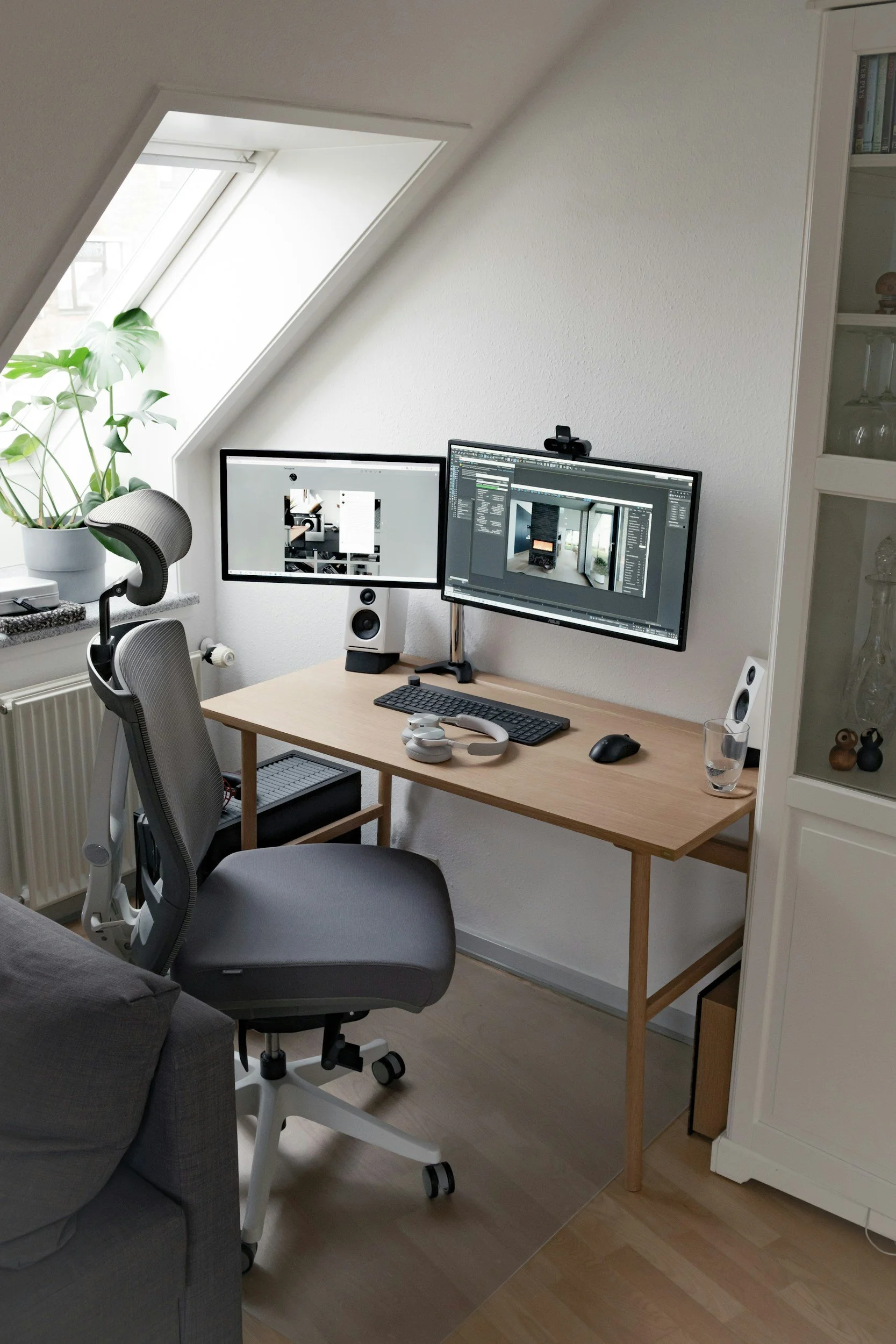
Professionals often spend thousands of dollars on dual monitors, high-speed docks, and premium laptops. They completely ignore the physical infrastructure supporting their own body.
They buy a $250 chair from a big-box store. Within eight months, the hydraulic cylinder sinks. The synthetic foam seat pad compresses into a hard block. The plastic armrests rattle.
If you are working a standard W2 job during the day and grinding out 1099 contract work at night, you are sitting in that chair for ten to twelve hours. A degraded seat directly causes lumbar fatigue, which destroys your focus and caps your earning potential. You end up replacing the cheap chair every two years, throwing good money after bad.
Side note: DO NOT buy the cheap gaming chair!!! These have absolutely horrendous lumbar support. Been there - done that…back problems still here.
The Steelcase Acquisition
The highest-yield chair in the home office category is the Steelcase Gesture.
This chair retails for around $1,500. It is a massive upfront cost for a piece of furniture, but it is not furniture. It is biomechanical equipment.
The Gesture was engineered by studying the micro-movements of the human spine interacting with modern technology. When you recline to look at a phone, the seat pan automatically glides forward to keep your lower back completely supported. The armrests articulate 360 degrees. They support your elbows whether you are typing intensely on a keyboard or leaning back reading a tablet.
The Warranty Leverage
The true value of this acquisition is the manufacturer guarantee. Steelcase provides a 12-year, 24/7 warranty. This covers the mechanisms, the gas cylinder, and the frame.
When you amortize the $1,500 cost over the guaranteed twelve-year lifespan, your actual cost of ownership is $125 a year. That breaks down to roughly thirty cents a day.
You are paying thirty cents a day to eliminate back pain, optimize your posture, and ensure your physical hardware can keep up with your required daily output. Buying anything less is simply a liability.

Lobster Elite — Getting Infinite Tennis Reps without a Hitting Partner
Paying a hitting partner is a recurring expense that limits your improvement. Buying the hardware is a one-time capital expenditure that provides infinite, on-demand repetition.
The Hourly Trap
Improving at a technical sport requires massive volume. If your backhand is breaking down under pressure, you do not need to read a book about it. You need to hit five hundred consecutive backhands until the muscle memory becomes permanent.
Most players attempt to solve this by hiring a hitting partner or taking a private clinic. They pay $60 to $80 an hour. Half of that time is wasted picking up stray balls, taking water breaks, and dealing with the human element of inconsistent feeds.
You are paying a massive premium for a highly inefficient training environment. You are renting time. You need to own the delivery mechanism.
The Hardware Solution
To remove the human bottleneck, the premier acquisition is the Lobster Sports Elite Two Ball Machine.
This unit retails for approximately $1,800. It transforms a standard public court into a high-density training facility. You load it with a case of premium balls—whether your preference leans toward the heavy felt of a Wilson US Open or the lively bounce of a Penn Pro Penn Marathon—and the machine goes to work.
It holds 150 balls and delivers them at speeds up to 80 miles per hour. More importantly, it features random horizontal and vertical oscillation. It does not just feed you the same flat ball down the middle. It forces you to move corner to corner, dealing with heavy topspin and slicing backspin.
The Lifecycle Math
The break-even calculation on this hardware is incredibly fast.
If you currently pay a hitting partner or coach $60 an hour just twice a week, your monthly burn rate is $480. You spend nearly $6,000 a year just to get a decent sweat in.
The $1,800 capital expenditure for the Lobster machine pays for itself in exactly three and a half months. After week fourteen, your training is mathematically free. You can go to the court at 6:00 AM on a Tuesday or 9:00 PM on a Sunday. You never have to coordinate schedules with another human being again. You just turn the machine on and hit until you achieve technical perfection.

Bringing Your Coffee Supply Chain In-House
Outsourcing your morning coffee introduces massive daily friction and bleeds capital. Here is the mathematical argument for a $2k+ Swiss hardware acquisition.
The Supply Chain Failure
Most professionals accept the daily coffee shop run as a fixed cost of doing business. They spend $7 on a latte, stand in a queue for twelve minutes, and deal with inconsistent quality depending on which barista is working the bar.
When you run the math on this habit, it is a catastrophic leak in your personal profit and loss statement.
Spending $7 a day equals roughly $2,550 a year. But the true cost is the time. If you waste twelve minutes a day acquiring that coffee, you are burning over seventy hours a year standing in a line. You are outsourcing a basic daily requirement to an inefficient third-party vendor and paying a massive premium for the privilege.
The strategy is vertical integration. You must control the supply chain by bringing the production hardware into your own kitchen.
The Pod Trap
The amateur attempt at solving this problem is buying a cheap pod-based machine like a Nespresso or Keurig.
This is a false economy. The hardware is cheap upfront, but the recurring cost of the proprietary capsules is exorbitant. You are paying the equivalent of $50 per pound for stale, pre-ground coffee sealed in aluminum. Furthermore, the extraction pressure and water temperature on these plastic machines are entirely insufficient to produce a structurally sound espresso.
You must bypass the razor-and-blades business model entirely.
The Swiss Engineering Solution
To replicate true commercial quality without the friction of manually tamping and dialing in espresso shots every morning, the premier asset is the Jura E8 Automatic Coffee Machine.
Jura represents the pinnacle of Swiss fluid engineering. This unit retails for approximately $2,799. While the initial capital expenditure induces sticker shock for most consumers, it is the only machine that mathematically justifies its own existence.
1. The Precision Grinder The machine features a built-in conical burr grinder. It holds whole beans and grinds them exactly three seconds before extraction. This guarantees zero oxidation and maximum flavor yield. You buy fresh beans from a local roaster at $18 a bag, reducing your per-cup cost from $7.00 down to roughly $0.40.
2. The Fluid Dynamics The Jura utilizes a proprietary pulse extraction process. Instead of forcing water through the grounds in a single continuous stream, it pulses the water at exact micro-intervals. This maximizes the extraction time, resulting in a thick, rich crema that matches any commercial machine in a high-end cafe.
3. The Zero-Friction Interface You do not need to learn how to froth milk. The machine handles the thermodynamics automatically. You press a single button on the glass touchscreen, and the internal system precisely heats, foams, and layers the milk directly into your glass, followed by the espresso. It then automatically flushes the milk system with boiling water to prevent bacterial buildup.
The Lifecycle Math
Do not view the $2,799 price tag as a purchase. View it as an equipment lease that you pay off in less than a year.
If you eliminate the $2,550 annual coffee shop expense and replace it with $300 worth of whole beans, the Jura E8 completely pays for itself by month 15. Every single year after that, you are retaining over $2,000 in liquid capital while drinking a superior product and saving seventy hours of your time, especially with a Swiss product that will likely last you 10 yrs+.
Stop funding the expansion of a coffee franchise. Capitalize your own kitchen.
Why Smartphone Lenses Distort High-Value Travel
You spent $10,000 on a transpacific flight and a luxury resort. Relying on an iPhone to document the experience is a catastrophic data capture failure. Here is the hardware for optical reality.
The Algorithmic Illusion
The modern smartphone does not take photographs. It gathers light data and uses artificial intelligence to heavily guess what the image should look like.
When you take a picture of a sunset in the Maldives with a phone, the software aggressively sharpens the edges, artificially saturates the blues, and flattens the depth of field. The resulting file is a synthetic composite, not an optical reality. Furthermore, the physical sensor inside a phone is roughly the size of a fingernail. It simply cannot absorb enough photons in low-light environments, resulting in grainy, degraded images when shooting inside a dim Michelin-starred restaurant.
The Sensor Real Estate Solution
To capture a high-fidelity record of your capital expenditures, you must bypass computational guessing and rely on pure physics. You need massive sensor real estate.
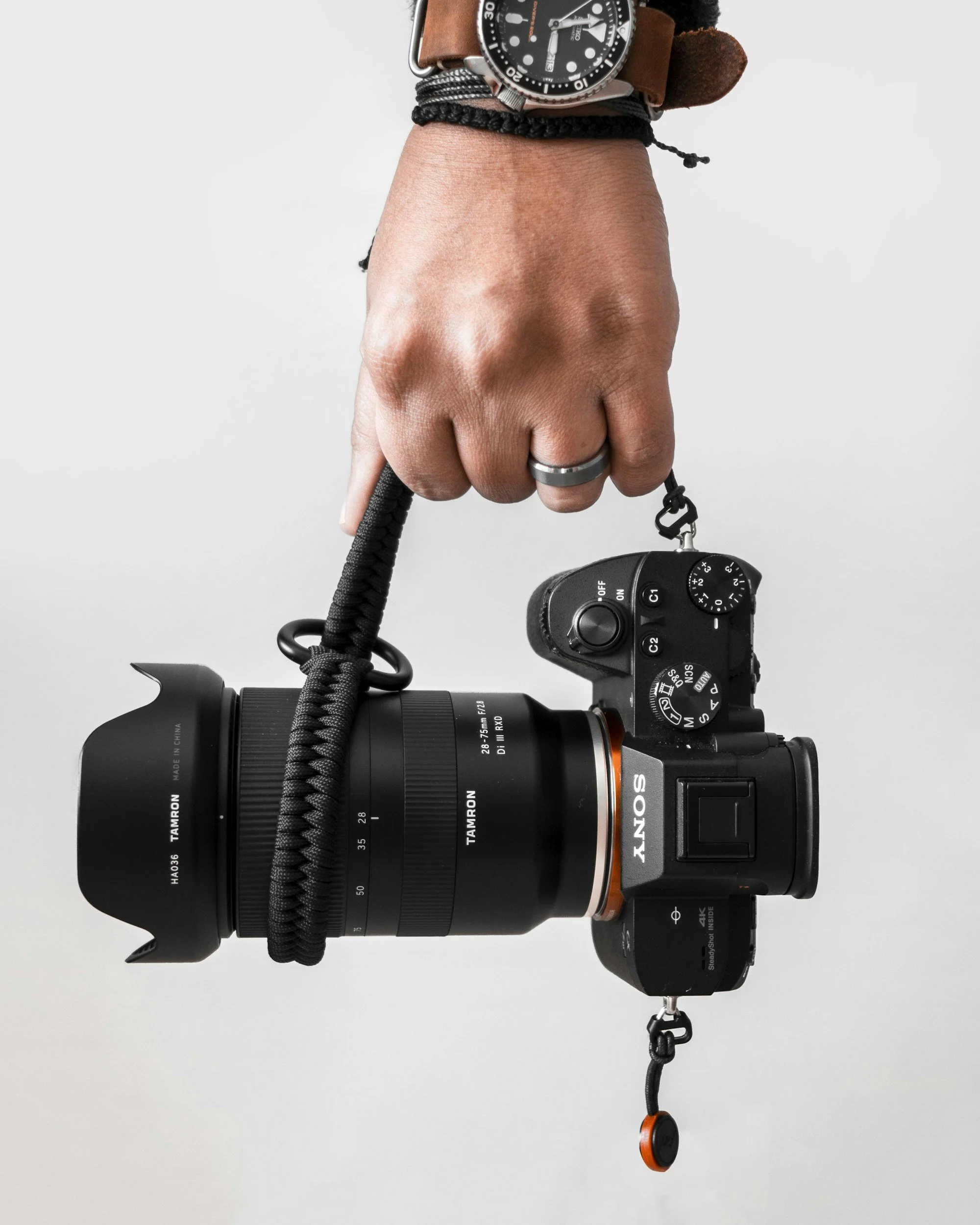
Dragging a heavy, interchangeable-lens DSLR camera across Europe introduces too much physical friction. The operational sweet spot is the Sony RX100 VII.
This unit fits entirely inside a jacket pocket.
The Hardware Superiority
The RX100 VII utilizes a 1-inch sensor, which is physically massive compared to a smartphone. This allows it to capture authentic depth of field—where the subject is razor-sharp and the background naturally blurs through optical physics, not software simulation.
It also features a true mechanical 24-200mm zoom lens. When you digitally zoom on a phone, you are just cropping pixels and destroying image quality. The Sony utilizes physical glass elements to pull subjects closer without losing a single megapixel of resolution. It shoots 20 frames per second, ensuring you capture the exact microsecond of an action shot without motion blur.
The Final Assessment
You do not optimize your flights, your hotels, and your dining only to secure a low-resolution, iPhone picture of the memory. The Sony RX100 VII guarantees high-fidelity data retention without the logistical burden of professional camera gear.