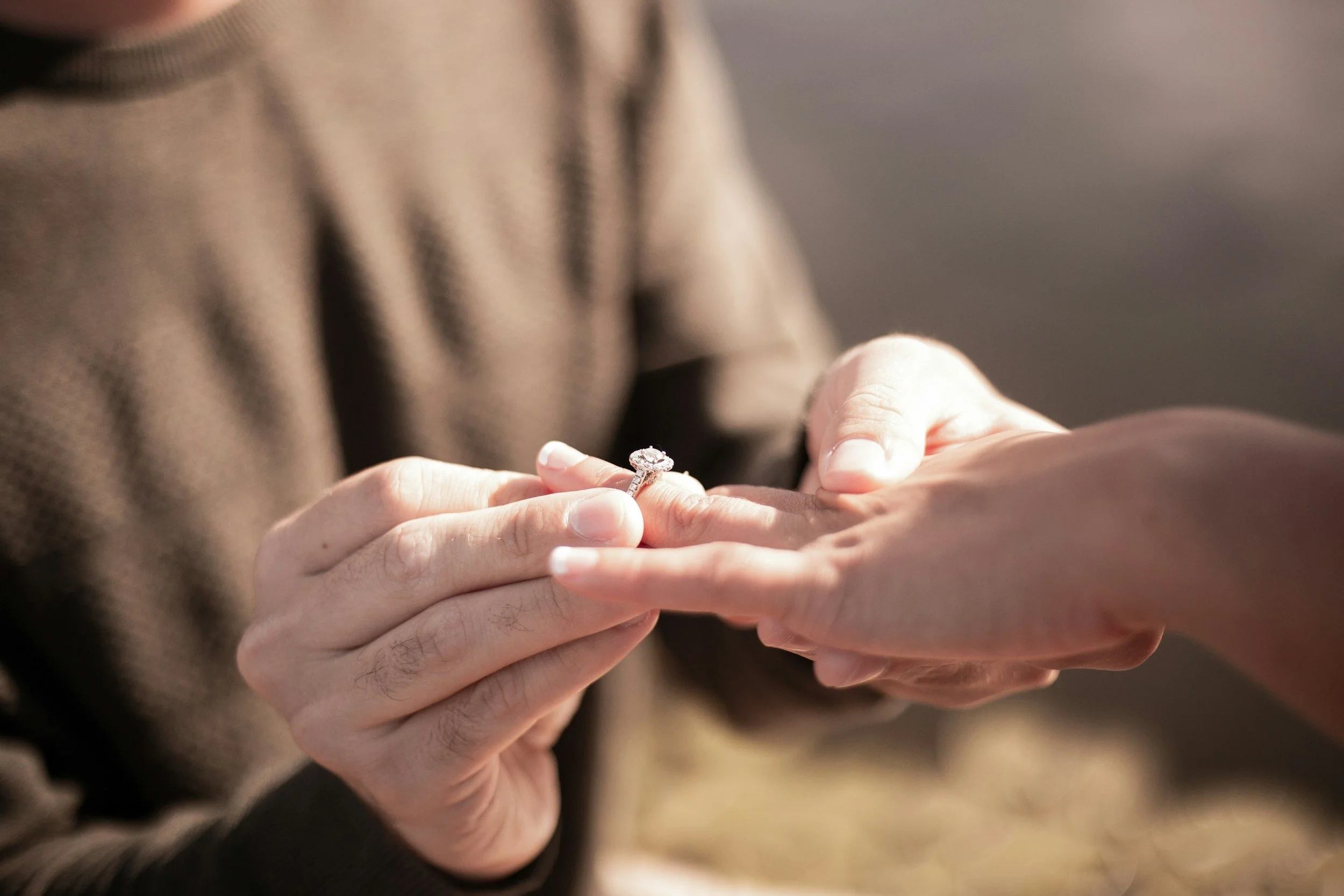
The "Surprise" Paradox: Why Total Secrecy is a Single Point of Failure
Amateurs try to surprise the "What," "Where," and "When." Professionals redact the "When" but collaborate on the "What." Here is the risk mitigation protocol.
The Executive Summary
The cultural narrative tells you that a proposal must be a total shock. You pick the ring in secret, you pick the date in secret, and you drop to one knee while she is in her pajamas.
This is a logistical and emotional disaster.
Risk 1 (The Ring): You buy a Halo Cut when she wanted a Solitaire. Or platinum setting instead of yellow gold. Or a round brilliant instead of a pear shape. Or a 1.0Ct natural since that’s what you could afford instead of a 3Ct lab? (Cost to fix: $500–$2,000 in restocking fees, weeks/months time wasted, her reaction when she really didn’t like it especially when you’re trying to express the pinnacle of your love & future?: priceless).
Risk 2 (The Image): You hired a professional photographer, but she hasn't had a manicure in 3 weeks. She will hide her hand in every photo. Or she wished she could’ve worn that new dress she had and didn’t look so casual. Or got her hair/makeup/shoes/etc., the list goes on….
Risk 3 (The Size): The ring doesn't fit. The moment is ruined by physics.
Risk 4 (The Relationship): She wasn’t ready just yet for the next big step and would’ve loved a heads-up so you guys could have had a conversation around it all first.
We advocate for the Redacted Info Strategy. You do not keep the Project a secret. You only keep the Execution Date a secret.
Phase 1: The "What" (Collaborative Ring Selection)
Never guess the specs. The engagement ring is a piece of engineering she will wear every day for 40+ years. The margin for error is zero.
The Protocol:
The "Pinterest Audit": Ask to see her board.
The "Showroom Visit": Go to a jeweler together. Do not bring a wallet. This is a data-collection mission. See what she likes and what she prefers. This is HER ring.
The Variables: Confirm three hard data points:
Shape: (Oval vs. Round vs. Emerald).
Metal: (Yellow Gold vs. Platinum).
Setting: (Pave band vs. Plain band).
Once you have these specs, you go dark. You buy the diamond in private using the guide provided in the Diamond Calibration. She knows what is coming, but not which specific stone or when.
Phase 2: The "Where" (The 'Manicure' Vector)
The number one complaint from women after a surprise proposal? "My nails looked terrible." This sounds trivial to you, but it is critical to your fianceé and future partner.
The Decoy Maneuver: You need a pretext to get her "Camera Ready" without revealing the mission.
The "Fake Event": "Hey, my company is doing a holiday dinner/awards night on Friday. Dress code is cocktail." Or “my best friend is doing a dinner party where we’ll be dressed up and going out after.”
The "Girls' Day": Enlist her best friend (The Asset Handler). Have the friend take her to get her nails done 2 days prior "just for fun."
This ensures the Operational Conditions (Outfit, Hair, Nails) are optimal without spoiling the surprise of the event itself.
Phase 3: The "When" (The Only True Surprise)
This is the only variable you redact. If she knows you bought a ring, and she knows she is dressed up for a "dinner," she will suspect something. Use that tension.
The False Positive: Take her to a nice dinner on Friday. Do not propose. Let the tension deflate. (this could be a little risky though, if she’s been waiting for some time..)
The Strike: Propose on Saturday morning on a walk, or Sunday at sunset.
The "Tuesday" Rule: Everyone expects a proposal on a Saturday night or a holiday (Christmas/Valentine's). Nobody expects a proposal on a Tuesday evening after work. If your goal is genuine shock, leverage the Element of Unpredictability.
Final Calibration
Stop treating the proposal like a covert ops mission where the target knows nothing. Treat it like a Joint Venture Launch and you’re the PM coordinating everything.
Stakeholder Alignment: She picks the Ring Style.
Market Readiness: She is dressed for the photos.
Launch Date: That is your surprise.
Need more help? Book a Proposal Strategy Session

The 12-Minute Window: Why "Sunset" is a Trap (And How to Calculate the Real Golden Hour)
Amateurs plan for "Sunset." Professionals plan for Solar Elevation Angles. Here is the physics of lighting your proposal.
The Executive Summary
If you tell a photographer "We are proposing at sunset," you have already introduced a critical failure point.
"Sunset" is a 30-minute transition event with rapidly changing Lux values (light intensity).
Too Early (Solar Elevation > 6°): The sun is harsh. You get "Raccoon Eyes" (deep shadows in the eye sockets) and squinting.
Too Late (Solar Elevation < -4°): The sun has dipped too far. The camera sensor has to pump up ISO, introducing digital noise (grain). The background goes black.
We don't guess. We calculate the Target Azimuth to ensure the light hits the diamond, not the camera lens.
Phase 1: The Physics of "Golden Hour"
Golden Hour isn't an hour. Depending on your latitude and the season, it is often a 12-to-20-minute window.
The Target Angle: 0° to 6° Elevation
This is the "Cinematic Safe Zone."
The Look: The sun is low enough to be diffused by the atmosphere (soft light), but high enough to provide directional rim-lighting on the subject.
The Diamond: This is the only time a diamond will sparkle in a photo without a flash. The direct rays enter the table at a low angle, creating maximum fire dispersion.
The "Blue Hour" Alternative (Civil Twilight)
Target Angle: -4° to -6° (Below Horizon).
The Look: Moody, deep blue skies, city lights turning on.
The Risk: Requires a photographer with a full-frame sensor and fast glass (f/1.2 or f/1.4). If your photographer uses a kit lens, this will look muddy.
Phase 2: The Site Survey (The "SunSeeker" Protocol)
You cannot pick a spot just because it "looks nice." You must audit the Solar Vector.
The App: Download SunSeeker or PhotoPills.
The Audit:
Hold up your phone in AR Mode at the exact spot you plan to kneel.
Trace the Yellow Line (Sun Path).
Identify Obstructions: Will that building or mountain block the sun before it hits the 6° target angle?
Scenario: You plan for 7:00 PM sunset. But a mountain to the West blocks the sun at 6:30 PM. You just lost your lighting window.
The "Backlight" Rule:
Never face the sun directly.
Incorrect: You —> Partner —> Sun. (Your partner squints & you are a silhouette).
Correct: Sun —> Side/Back Angle —>Couple. (Creates a "halo" effect on hair/shoulders; faces are evenly lit).
Phase 3: The "Crowd Control" Variable
The best lighting usually coincides with the highest foot traffic.
If you propose at the exact moment of sunset at a popular landmark (Griffith Observatory, Brooklyn Bridge), you will have 500+ tourists in your background.
The "Dawn Patrol" Strategy
We often advise clients to invert the schedule.
Sunrise Golden Hour: The physics are identical to sunset, but the human density is near zero.
The Asset: You get the entire venue to yourself.
The Logistics: It requires waking up at 4:30 AM.
The Trade-off: Is privacy worth the sleep deprivation? (Unfortunately: …Yes).
Final Calibration
Do not leave the single most important photo of your life to chance.
Download SunSeeker.
Check the obstruction line.
Set the "Knee Drop" time for exactly 10 minutes before official sunset.
If you are off by 15 minutes, you lose the light. If you are on time, you get the shot.